Will Psilocybin Be Found Throughout the Universe?
More than 220 species of mushrooms are now known to contain psilocybin

Will Psilocybin Be Found Throughout the Universe?
More than 220 species of mushrooms are now known to contain psilocybin. What’s striking is that these species don’t all share a single evolutionary origin—psilocybin appears to have arisen multiple times, independently. These psilocybin species have circumnavigated the Earth, appearing on every continent… except, so far, Antarctica.
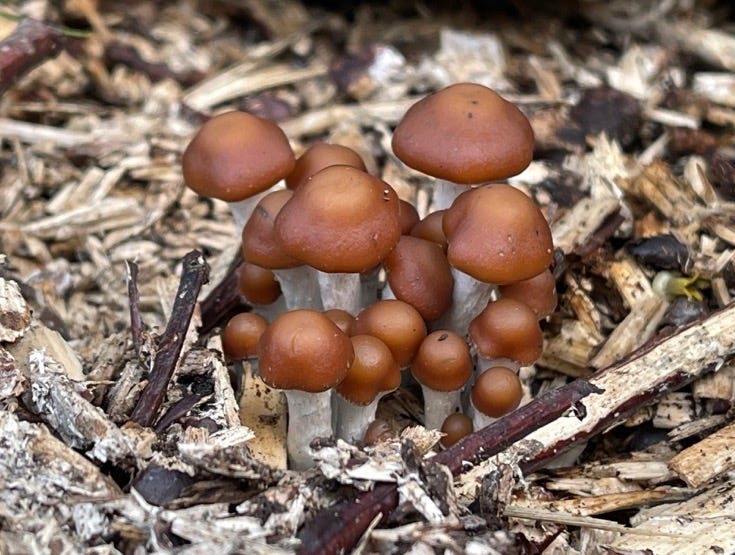
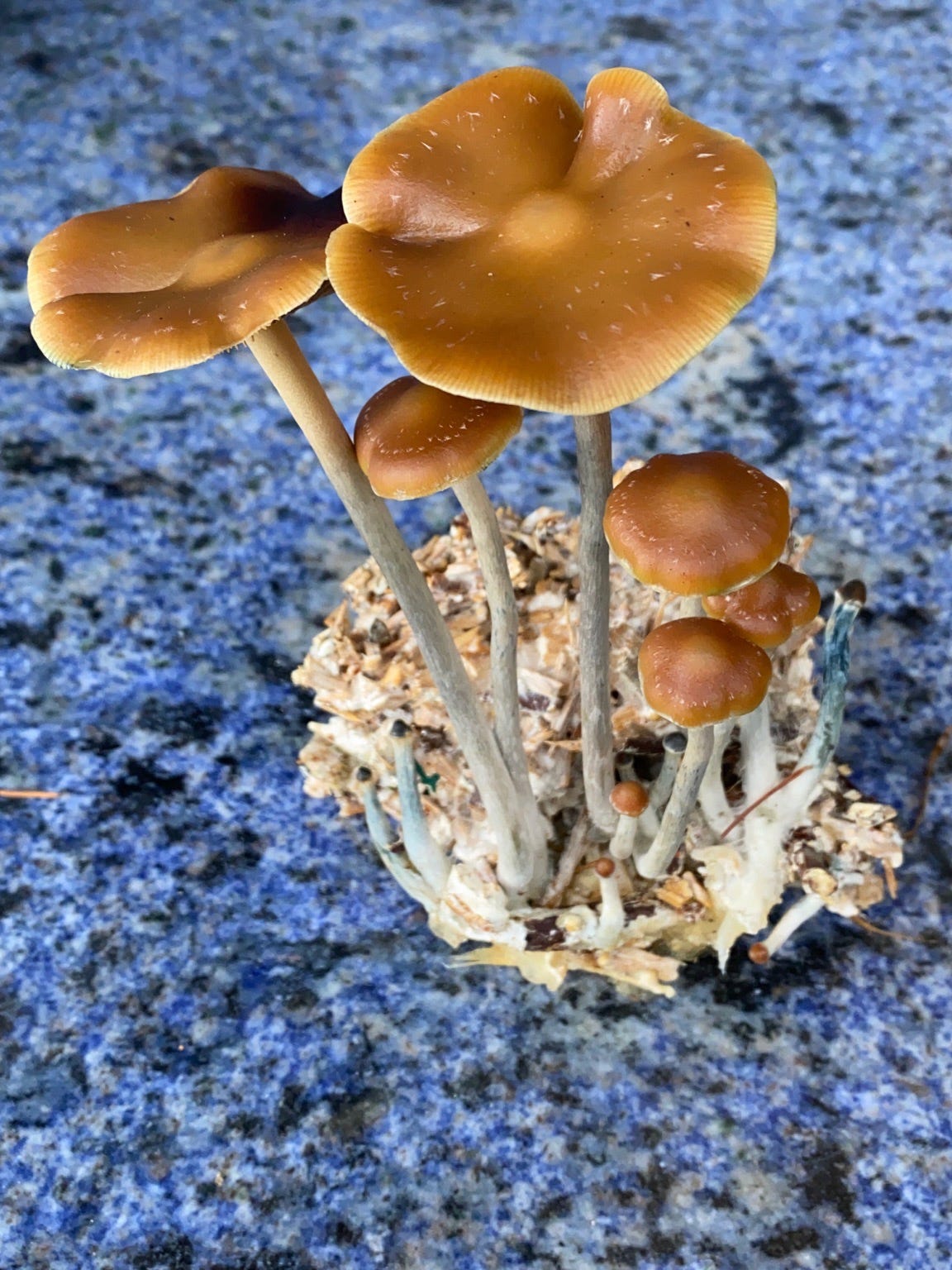
Psilocybe cyanescens, a potent psilocybin mushroom. Note bluing on stems. (P. Stamets photos.)
That raises a deeper question. Is psilocybin simply a byproduct of life emerging wherever conditions allow? Or does its repeated appearance hint at something more fundamental?
I want to explore a possibility—one that may sound improbable today, and perhaps unprovable in our lifetimes.
First, some context.
Psilocybin is often called the “magic molecule” in psychedelic mushrooms. Psilocybin is remarkably stable, but it’s a prodrug. Once ingested, it converts into psilocin, a more fragile compound that binds to our 5-HT (serotonin) receptors, altering—and many would argue enhancing—consciousness. We now know that psilocin stimulates new neurons to grow, to fork, to form new connections: increasing synaptogenesis and neuroplasticity.
Both psilocybin and psilocin belong to a broader family of compounds known as tryptamines. These molecules closely resemble serotonin, one of the body’s primary neurotransmitters (5-hydroxytryptamine), which plays a central role in transmitting signals throughout the nervous system.
Biologically, psilocin is typically synthesized from L-tryptophan into a tryptamine, through a series of enzymatic steps. Within mushrooms, these compounds accumulate as the fruiting bodies emerge from the mycelial network below.
But here’s where things become even more intriguing.
DMT (dimethyl tryptamine) is surprisingly widespread across the three kingdoms: Fungi, Plantae and Animalia. DMT is the active ingredient in found in ayahuasca (the shrub Psychotria viridis), some Acacia trees (Acacia acuminata, Acacia obtusifolia), in the young leaves of Phalaris grasses, the root bark of the shrub Mimosa (Mimosa tenuiflora), from the glands of the Sonoran Desert toad (Incilius alvarius) in the form of 5-MeO-DMT (5-methody-N,N dimethyltryptamine). Astonishingly even some sponges (Smenospongia aurea and Smenospongia echina), whose habitats are increasingly in jeopardy, have a form of DMT.
Why are these molecules so ubiquitous?
I think there may be a deeper answer.
Asteroids impact planets and in doing so, make material contributions. On September 8, 2016, NASA launched the OSIRIS-REx mission to the asteroid Bennu. Bennu is a relatively small asteroid—about 500 meters (1,600 feet) in diameter—formed from primordial material roughly 4.6 billion years ago, before Earth itself coalesced into form a planet 4.5 billion years ago. It orbits between Mars and Jupiter and carries a small (0.037%) chance of impacting Earth in the year 2182.
The spacecraft returned samples to Earth on September 24, 2023. Then, on November 27, 2025, NASA announced that tryptophan had been detected on Bennu.
This is extraordinary.
The presence of tryptophan on Bennu suggests that this amino acid—essential to life as we know it—can form in abiotic or prebiotic environments in space. From a chemical standpoint, converting tryptophan into tryptamines requires only a simple step: decarboxylation, the removal of carbon dioxide.
In other words, the building blocks of compounds like psilocybin may not be uniquely terrestrial.
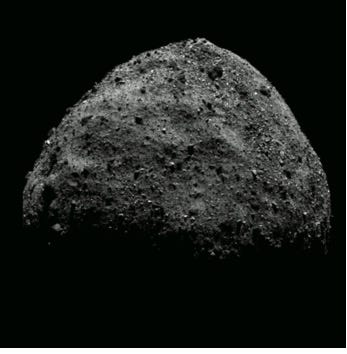
https://www.planetary.org/space-images/bennu-from-the-north
If tryptophan exists beyond Earth, it follows logically that tryptamines may as well.
So, what are the implications?
It opens the possibility—however speculative—that molecules like psilocybin and psilocin could arise throughout the Universe. If so, they may play a role in the emergence of consciousness wherever life takes hold.
This leads to a profound thought: perhaps consciousness is not an anomaly, but an intrinsic property of the Universe.
For much of my life, I’ve believed that matter gives rise to life. Increasingly, I’m drawn to the idea that matter also gives rise to consciousness—however limited or expansive that consciousness may be.
Fields like astrobiology—and astromycology—may ultimately evolve into something even broader: a science of universal awareness.
We may be embedded within a shared, Unified Field of Consciousness.
Indigenous knowledge systems have long pointed toward this understanding. Only recently has modern science begun to catch up. There is a lesson here—one that connects rather than divides us.
And this, to me, is a hopeful and profound thought: Psilocybin and DMT will be found throughout the cosmos, on other planets. This is the way of being.
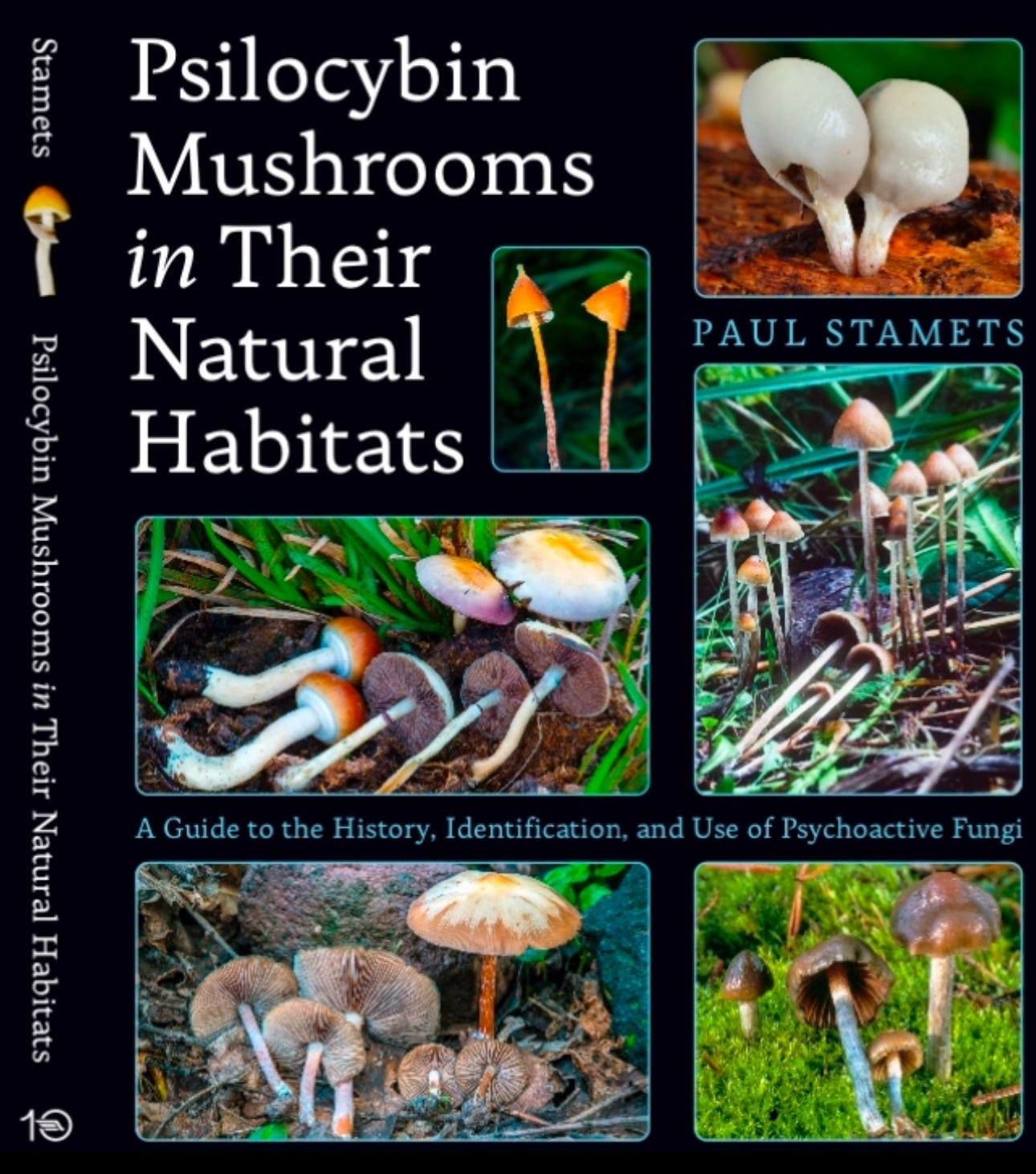
PS: For a deeper exploration of psilocybin-containing species, see my latest book:
Psilocybin Mushrooms in their Natural Habitats
This stopped me completely.
I've been sitting with the mycelium for a while now — writing about it, thinking through it, using it as a lens for understanding power, knowledge, and connection. The idea that intelligence doesn't need a center. That it moves through networks, not hierarchies.
But tryptophan on Bennu changes something.
If the building blocks of psilocybin predate Earth itself — if consciousness-expanding molecules travel through space on asteroids and seed planets — then the mycelium isn't just a metaphor for how knowledge moves between us. It might be the literal mechanism through which the universe learns to know itself.
You write: "perhaps consciousness is not an anomaly, but an intrinsic property of the Universe."
Indigenous knowledge systems have always known this. The molecules are just catching up.
What strikes me most is the independent evolution — 220+ species, no shared origin, same molecule. Nature finding the same solution across time and space without communication. Like ancient civilizations on separate continents orienting their monuments toward the same stars. Like certain blood types that don't fit the evolutionary timeline we think we know.
Something keeps arriving. In spores. In stone. In frequencies we're only beginning to measure.
Maybe we're not discovering consciousness. Maybe we're remembering it.
Thank you for this. Today of all days.
/Kitty Rose
Fascinating article, Paul, thank you. Intrigued by this:
"For much of my life, I’ve believed that matter gives rise to life. Increasingly, I’m drawn to the idea that matter also gives rise to consciousness—however limited or expansive that consciousness may be."
What if it's the other way around? What if consciousness gives rise to matter? I've come to believe that we are souls who have bodies...not bodies who have souls.